
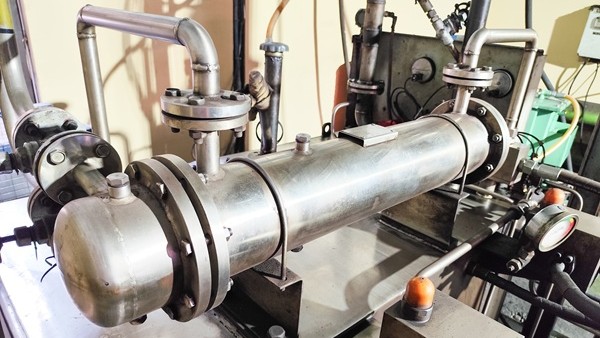
Scale is the crystalline deposit that forms on the inside of pipework when dissolved minerals come out of solution.
What Scale Formation Is
Scale is a hard, adherent layer of mineral crystals that grows on a surface rather than settling on it. The distinction matters: loose particulate that settles in low-velocity sections can usually be flushed, whereas scale has chemically bonded to the pipe wall and has to be dissolved or mechanically removed.
Composition follows the water chemistry. Calcium carbonate dominates in many cooling and process systems; calcium sulphate, magnesium salts and silica appear where the feed water or the process conditions favour them.
Why Scale Forms
Crystallisation begins when the concentration of a dissolved salt exceeds its solubility at the conditions prevailing at the surface. That threshold is not fixed. It moves with temperature, pH and pressure.
| Factor | Effect |
|---|---|
| Concentration above saturation | Precipitation begins once the threshold is crossed. |
| Temperature change at a surface | Many scales become less soluble as water warms. |
Where Scale Accumulates
Scale does not distribute evenly. It concentrates where the conditions that drive crystallisation are most severe, which is usually where heat enters the fluid or where pressure changes sharply.
Heat exchanger tubes and their feed lines are classic examples. So are the downstream faces of control valves, dead legs and sections operating below design velocity.
How Scale Affects Performance
Deposits impose cost in three ways at once:
- Reduced flow area and higher pressure drop across the system
- Increased pumping energy to maintain the same throughput
- Declining heat transfer coefficient as the layer thickens
Secondary effects follow. Deposits shield the surface beneath them, which can promote under-deposit corrosion and make subsequent cleaning more difficult.
Assessing a Scaling Problem
A useful assessment establishes three things: what the deposit is, where it is forming, and why there rather than elsewhere.
- Water chemistry analysis, including hardness, alkalinity and silica
- Deposit sampling and composition analysis
- Trending of thermal performance or pressure drop
- Inspection of pipework where performance loss occurs
- Review of cleaning history and cleaning frequency
Approaches to Scale Control
Water treatment, including softening, antiscalant dosing and pH control, addresses supersaturation at its source and remains the primary defence in most systems.
Cleaning addresses deposits that have already accumulated, whether by chemical dissolution, mechanical removal or controlled flushing.
Externally applied ultrasonic energy can also be used in installed piping where opening the system is difficult and the objective is to slow deposit accumulation between cleaning events.
Scale is rarely a single-cause problem. Where deposits persist despite treatment, the more productive question is usually why they concentrate in one location rather than another.
Frequently Asked Questions About Scale Formation
What is the difference between scale and fouling?
Scale is a specific type of fouling: a crystalline deposit formed when dissolved minerals come out of solution and adhere to a surface. Fouling is the broader term and includes biological growth, particulate deposition, corrosion products and organic residues, all of which behave differently and are assessed differently.
Does scale always form at the same rate?
No. Rate depends on supersaturation, temperature change across the surface, pH, flow velocity and surface condition. A system can run for months with no visible deposit and then accumulate quickly after a modest change in operating conditions.
How quickly does scale become a problem?
A thin layer is enough to matter. Thermal resistance rises with thickness, so a deposit measured in fractions of a millimetre can produce a measurable loss of heat transfer long before it restricts flow.
Can scale be removed without dismantling pipework?
Sometimes. Chemical descaling, controlled flushing and in-line mechanical methods can address accessible sections without dismantling. Where deposits are heavy or the geometry is complex, removal may require opening the system. The choice depends on the deposit chemistry and the pipework arrangement.
Does water treatment stop scale completely?
Rarely completely. Softening, antiscalant dosing and pH control reduce supersaturation and delay crystallisation, and they are the primary defence in most plants. They are less effective where temperature change at a surface is severe or where dosing control is inconsistent, which is why deposits often persist in specific locations rather than throughout a system.
Related guides
Dealing With Recurring Scale?
If deposits keep returning despite treatment and cleaning, the pattern usually points to something specific in the process conditions.
Tell us where the fouling occurs and how often you clean, and our team will review whether in-line mitigation is worth evaluating for your system.
Request Technical Assessment