
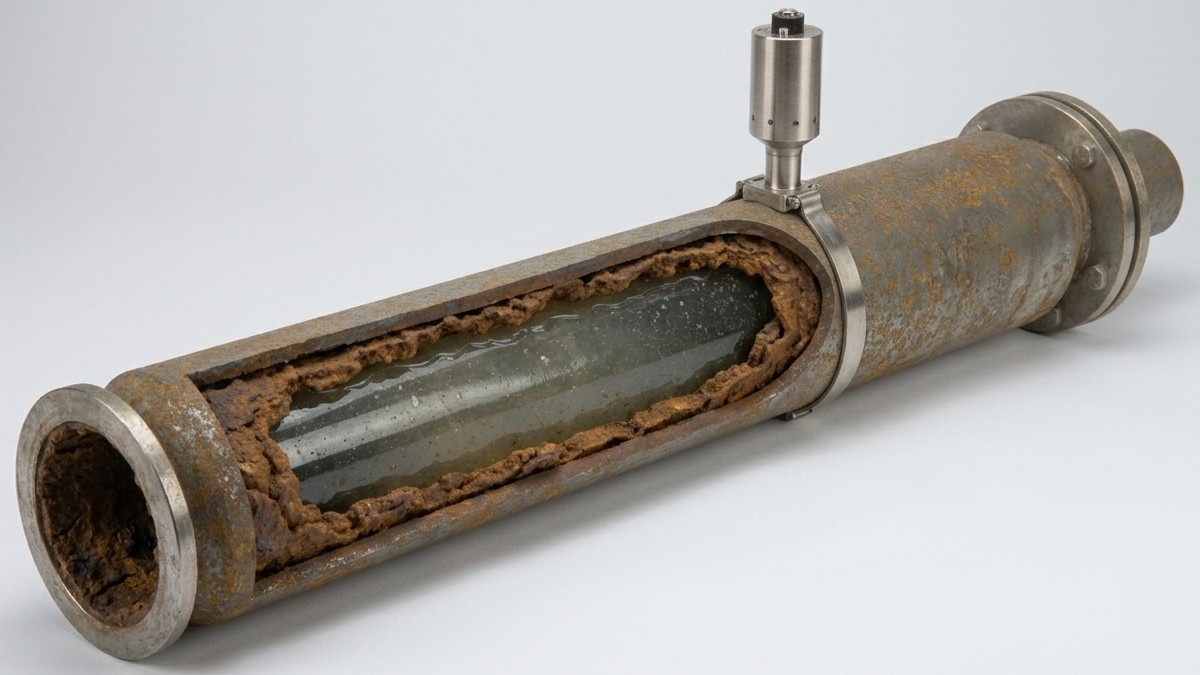
Ultrasonic fouling mitigation applies acoustic energy to installed pipework to influence how deposits form and adhere. The mechanisms are physical and reasonably well characterised; the outcomes are conditional on the deposit, the pipe and the operating conditions. Both halves of that sentence matter.
What Ultrasonic Fouling Mitigation Is
The term is often used loosely, so it is worth separating two objectives that are frequently confused. Cleaning removes deposits that have already formed. Mitigation attempts to reduce the rate at which they accumulate. They are different problems with different measures of success, and a technology designed for one is not automatically effective at the other.
Ultrasonic fouling mitigation belongs to the second category. It applies mechanical energy to the pipe wall while the process is running, with the aim of altering the conditions under which material arrives at, adheres to, and remains on the surface. Success is measured as an extended interval between cleaning events or a slower decline in performance — not as a restored clean surface.
How Energy Enters the Piping System
Transducers are mounted externally on the pipe and driven by a generator that produces modulated waveforms rather than a single fixed frequency. Piezoelectric or magnetostrictive actuators are typically operated in the region of 10 to 25 kHz, and the modulation is used to excite a range of structural responses rather than one resonant mode.
This matters because a pipe is a structure, not a uniform medium. Its response depends on diameter, wall thickness, support spacing, fittings and the fluid inside it. A narrow-band excitation that couples efficiently on one run may couple poorly on another, so wideband drive is used to increase the likelihood that useful axial, torsional and radial motion is induced across different geometries.
What Happens at the Pipe Wall
The effect of interest is close to the surface. When the wall moves, it moves relative to the fluid immediately beside it, and that velocity difference produces shear in the thin layer next to the wall. Two things raise that shear: a larger wall velocity amplitude, and higher frequency content, which confines the velocity change to a thinner viscous layer and therefore steepens the gradient.
In principle this means that, within safe structural and fatigue limits, increasing amplitude or effective bandwidth increases near-wall shear and therefore the potential to disturb deposits at the point where they adhere. Those limits are real and are part of the engineering: a pipe can be over-driven, and the constraint is usually mechanical rather than acoustic.
The Mechanisms That May Be Operating
Several mechanisms can act at once, and their relative contribution is not cleanly separable in the field. That is an honest limitation of the current state of practice rather than a gap in the explanation: the effects are coupled, and what is measured is the combined result.
| Mechanism | What it describes |
|---|---|
| Near-wall shear and agitation | Transient velocity at the wall steepens the gradient in the fluid beside it, raising local shear stress on deposits |
| Mechanical delamination | Impulsive stress waves initiate and propagate cracks within cohesive layers, breaking bonds that resist chemical dissolution |
| Flow-assisted removal | Material that has been weakened or detached is carried away by the process fluid, reducing re-attachment |
| Modal coverage | Wideband excitation increases the likelihood of engaging useful axial, torsional and radial motion across different pipe geometries |
| Enhanced mass transfer | For dissolvable scales, increased transport near the surface can dominate over mechanical effects |
Why Results Differ Between Systems
The single largest variable is the deposit itself. A thin, hard, chemically bonded mineral layer and a thick, soft, cohesive organic layer sit at opposite ends of the problem: the first is governed largely by mass transfer and surface chemistry, the second by mechanical cohesion and adhesion. The mechanisms behind these deposits are covered in scale formation in pipes and biofouling in industrial pipes.
Beyond the deposit, the structural response of the specific pipe run determines how much of the drive energy becomes useful wall motion. Wall thickness, support spacing, clamping, fittings and the presence of the fluid all change the picture. Two lines carrying the same product at the same temperature can therefore behave differently, and a result obtained on one is not automatically transferable to the other.
Where the Limitations Begin
The constraints are worth stating as plainly as the mechanisms:
- Treatment is local — it acts where transducers are mounted, not throughout a network
- It addresses accumulation, not existing deposit depth
- Effectiveness depends on deposit type and cannot be assumed to transfer between systems
- Drive levels are bounded by pipe structure, fatigue and mechanical integrity
- The relative contribution of each mechanism is not separately measurable in service
- It does not correct the chemistry that causes supersaturation or the conditions that promote biological growth
The last point deserves emphasis. Where the underlying cause is a water chemistry problem or an unaddressed biofilm, treatment at the pipe wall is dealing with a symptom. Where the cause is fouling that concentrates in a small number of installed sections that cannot readily be opened, it is addressing the actual constraint. That is the distinction that determines whether an application makes sense.
Thermal duties present a further case worth separating. Where the performance loss appears at a heat exchanger, the deposit is often forming upstream of the bundle rather than in it, which is discussed in heat exchanger fouling.
How Suitability Is Assessed
Assessment comes before technology selection, and it is mostly an exercise in narrowing uncertainty:
- Identify the deposit: sampling and composition, not assumption
- Establish where it forms and which locations actually set the cleaning interval
- State the objective in measurable terms — interval, chemical use, or a specific critical section
- Review pipe material, wall thickness, temperature and available mounting locations
- Confirm that the pipe run will respond usefully to excitation at the intended drive levels
- Trial on a representative section before committing to a wider scope
The purpose of this sequence is not to qualify as many applications as possible. It is to establish, before any commitment, whether the mechanism at work in a given system is one this technology can influence — and to say so clearly when it is not.
Ultrasonic fouling mitigation is neither a universal solution nor a marginal curiosity. It is a technology with describable mechanisms and describable limits, and the useful question is always which of those applies to a specific pipe, deposit and objective.
Frequently Asked Questions About Ultrasonic Pipe Cleaning
Does ultrasonic treatment remove existing deposits?
Not in the sense that cleaning does. Ultrasonic treatment can weaken the bond between a deposit and the pipe wall and can help transport material that has already loosened, but removing an established layer remains a cleaning operation. The distinction matters when specifying a system: treatment is aimed at the rate at which new material accumulates, not at the depth of what is already there.
What kinds of fouling may be influenced?
It depends on the deposit. Dissolved mineral scales and cohesive organic or polymeric layers do not respond in the same way, because the dominant mechanism differs — mass transfer near the surface in one case, mechanical disruption of an adhered layer in the other. Deposits that are soft, thick and weakly attached behave differently again from thin, hard, chemically bonded layers. This is why a single description of performance cannot be applied across fouling types.
Why do results differ between systems?
Because the variables that govern the effect vary widely: deposit chemistry, pipe material and wall thickness, operating temperature, flow regime, the structural response of the specific pipe run, and where transducers can physically be mounted. Two nominally similar lines can behave differently if one is heavily clamped and the other is free-spanning, or if one carries a deposit that responds to shear and the other does not.
Does ultrasonic treatment replace chemical cleaning?
Generally no. Water treatment and chemical cleaning address the chemistry of the system and remove what has already deposited; ultrasonic treatment acts on accumulation at the pipe wall. In practice they are complementary, and the more realistic expectation is a longer interval between cleans or a lower chemical severity during them, rather than the elimination of cleaning altogether.
How is suitability assessed?
By establishing what the deposit is, where it forms, and what the objective is — longer intervals, reduced chemical use, or protection of a specific critical section. That is followed by a review of pipe material, wall thickness, operating conditions and available mounting locations, and usually by a trial on a representative section before any wider commitment.
Related guides
Evaluating an Application?
If you are weighing whether ultrasonic fouling mitigation is worth assessing for a specific system, the starting point is the deposit and the location rather than the technology.
Tell us where the fouling occurs, what it consists of, and what you would like the interval to become, and our team will review whether an assessment is warranted.
Request Technical Assessment